
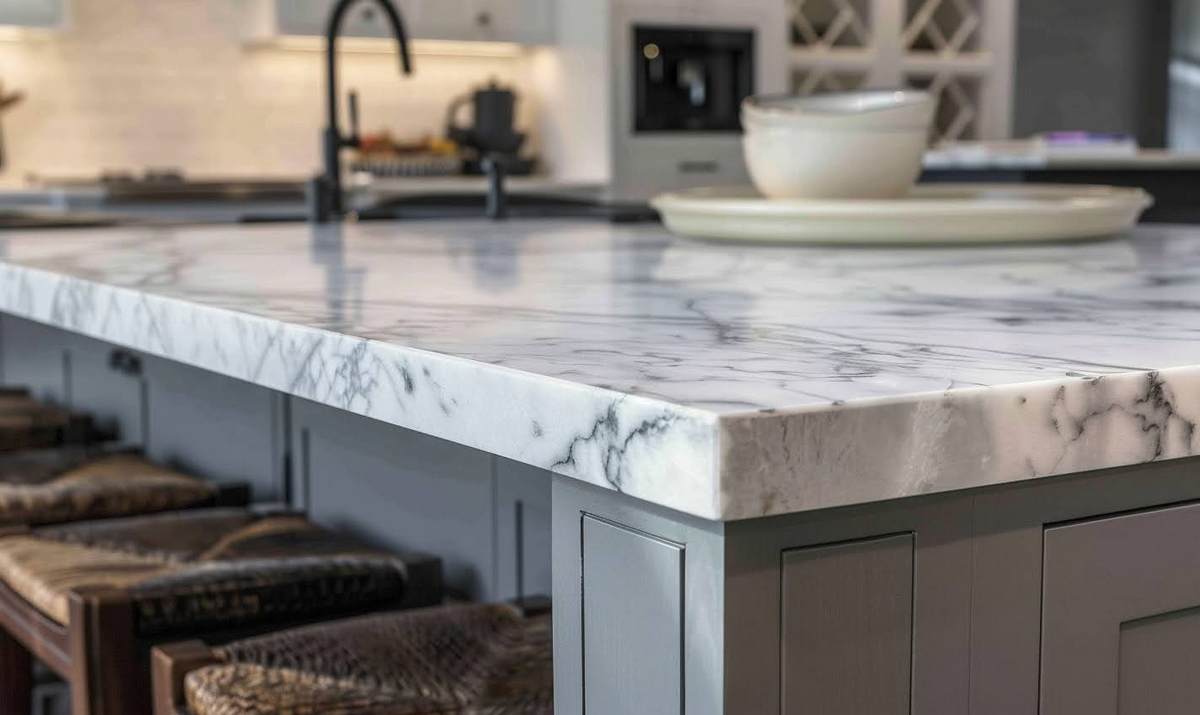
Selecting the right profile for your kitchen or bathroom remodel begins with dimensions. Slab depth influences structural stability, cabinet preparation, edge design, and total installation costs. This guide covers exact specifications, performance trade-offs, weight loads, and regional standards to help you select the ideal slab depth for your project.
How thick is a quartz countertop?
Homeowners often ask how thick is quartz countertop material straight from the manufacturer. Slabs exit production lines in 3 calibrated depths: 1.2 cm, 2 cm, and 3 cm. In US residential design, 2 cm and 3 cm dominate kitchen and vanity installations.
The physical depth of the engineered material determines how fabricators handle the slab. A 1.2 cm slab measures roughly ½″. A 2 cm slab measures approximately ¾″. A 3 cm slab measures about 1¼″.
Engineered slabs combine roughly 90% to 93% ground quartz crystals with 7% to 10% polymer resins and color pigments. Because resin binds the minerals tightly under extreme pressure, even thinner profiles possess high flexural strength compared to natural marble or limestone.
Visual profile height can differ from the physical slab depth. Fabricators frequently use 2 primary edge buildup methods:
- Laminated edges: Fabricators glue a matching strip of quartz beneath the outer perimeter. A 2 cm slab with a 2 cm drop strip creates a finished 4 cm profile.
- Mitered apron edges: Slabs are cut at a 45° angle and joined seamlessly. This method allows 2 cm or 3 cm slabs to present an edge face of 5 cm, 7 cm, 10 cm, or more without requiring solid, ultra-heavy slabs.
What is the standard countertop thickness?
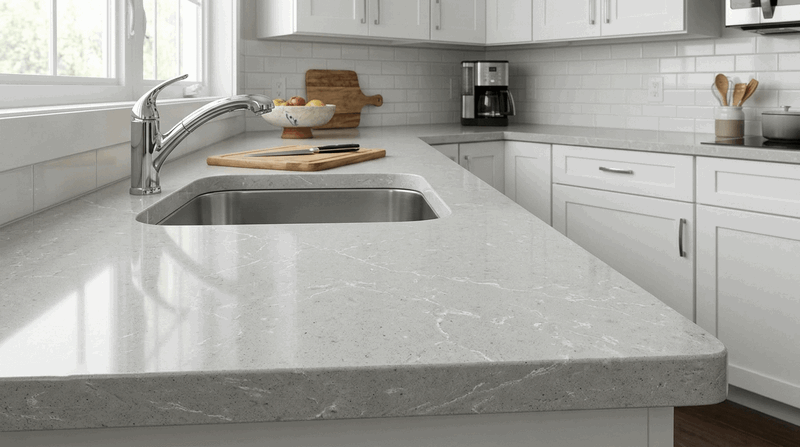
The standard quartz countertop thickness in modern residential kitchens is 3 cm. It provides an upscale appearance and mounts directly on top of level cabinet boxes without requiring secondary subtop decking.
Regional preferences influence what local fabricators consider the baseline residential specification. In eastern and midwestern states, 3 cm represents the default specification for residential kitchens. In western states, 2 cm remains popular due to historical fabrication traditions and easy edge buildup customization.
| Thickness | Metric / Imperial | Weight per Sq Ft | Common Applications | Subtop Required? |
| Ultra-Thin | 1.2 cm (~½″) | ~6 lbs to 7 lbs | Vertical wall cladding, backsplashes, fire surrounds, shower enclosures | Yes (if used horizontally) |
| Standard | 2 cm (~¾″) | ~10 lbs to 11 lbs | Bathrooms, contemporary kitchens, vertical panels, mitered edges | Yes (⅝″ or ¾″ plywood) |
| Premium | 3 cm (~1¼″) | ~15 lbs to 16 lbs | High-traffic kitchens, kitchen islands, commercial bars, heavy-use worktops | No (installs directly on cabinets) |
1.2 cm Profile
1.2 cm slabs serve primarily as vertical cladding. Fabricators use them for full-height backsplashes, bathroom wet walls, and fireplace surrounds. Their lighter weight simplifies vertical mechanical fastening and reduces structural strain on interior framing. Some commercial projects use 1.2 cm surfaces supported by dense substrate backer boards, but horizontal kitchen usage is rare.
2 cm Profile
2 cm material delivers clean, minimalist sightlines well suited for contemporary, Scandinavian, or European kitchen aesthetics. While popular on its own, US fabricators frequently laminate or miter 2 cm material to construct thicker perimeter profiles. It is the dominant choice for bathroom vanities because smaller vanity tops do not experience extreme center-span loads.
3 cm Profile
3 cm slabs account for the majority of luxury kitchen remodels. The 1¼″ edge delivers a substantial, solid profile straight off the fabrication line. It eliminates the labor required to glue separate edge strips for standard profiles. It also speeds up residential installation schedules.
2 cm vs. 3 cm quartz: which thickness should you choose?
Choosing between 2 cm and 3 cm involves balancing aesthetic goals, cabinet framing, edge styling, and budget allocations.
The typical countertop thickness used across major design styles depends on the overall kitchen aesthetic. Modern kitchens favor either crisp 2 cm profiles or massive 6 cm mitered block islands. Traditional and transitional homes gravitate toward 3 cm eased, beveled, or ogee perimeter profiles.
Cabinet Preparation and Subtops
Installation mechanics differ significantly between the 2 formats:
- 2 cm installation demands a full subtop: Installers secure ⅝″ or ¾″ exterior-grade plywood directly across base cabinet frames. The quartz slab rests flat on this wooden decking to prevent point-load cracking. Fabricators laminate a 2 cm drop edge around visible sides to hide the plywood substrate beneath.
- 3 cm installation requires no subtop: 3 cm slabs mount directly onto level cabinet perimeters with 100% silicone adhesive dabs. Installers place structural shims beneath low spots. No plywood layer is needed, preserving clearance beneath low-profile counter appliances.
Edge Profile Versatility
Selecting a decorative edge profile depends directly on whether your layout follows a 2 cm or 3 cm countertop thickness standard. Detailed edge styles such as double radius, bullnose, ogee, and cove require sufficient depth to execute clean cuts without chipping:
- 3 cm material accepts complex edge profiles directly into the solid body of the slab. The resulting curves display unbroken color and veining.
- 2 cm material handles simple eased or pencil edges well. For complex profiles, fabricators must laminate an extra strip below, which creates an edge seam that may disrupt intricate veining patterns.
Structural Weight and Handling
Structural loading affects both transit and floor framing:
- 2 cm slabs weigh roughly 10 lbs per sq ft. An average kitchen surface area of 45 sq ft equates to roughly 450 lbs of quartz material.
- 3 cm slabs weigh roughly 15 lbs to 16 lbs per sq ft. That same 45 sq ft layout totals roughly 700 lbs of quartz material.
Most modern cabinet boxes built from ½ in or ¾ in plywood easily support either profile. However, homes with long cantilevered joists, older floor framing, or elevated installations benefit from the reduced dead load of 2 cm slabs.
Overhangs for Breakfast Bars and Islands
Overhang limits define how far a slab can project past cabinets before requiring steel corbels or structural support frames:
- For 2 cm quartz: Slabs can project unsupported up to a maximum of 8″. Any overhang extending past 8″ requires steel flat brackets spaced every 24″ to prevent snapping under downward pressure.
- For 3 cm quartz: Slabs can safely cantilever unsupported up to 10″ or 12″, provided at least 70% of the total slab width remains fully supported by base cabinetry. Any overhang beyond 12″ requires concealed steel brackets, posts, or decorative corbels.
Does quartz countertop thickness affect strength?
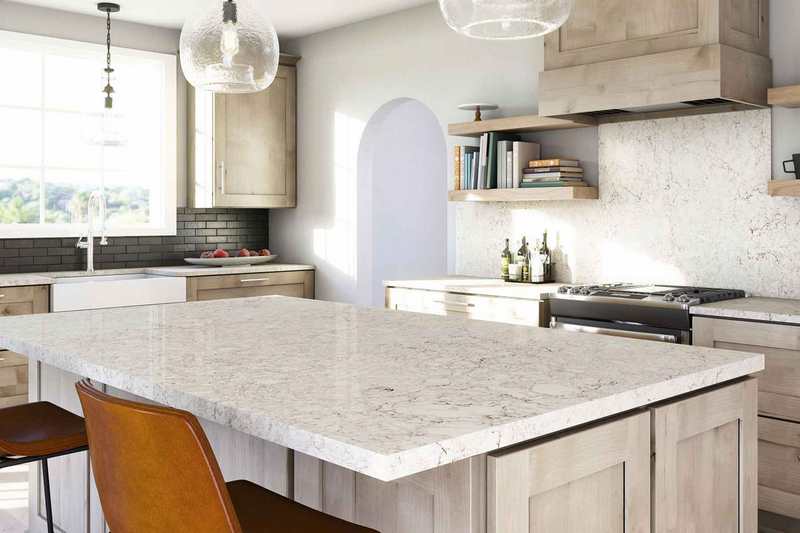
Yes, quartz countertop thickness directly governs the impact resistance, load capacity, and deflection limits of your finished installation.
Engineered quartz combines hard silica minerals with elastomeric polymer resins. This composition gives engineered slabs superior flexural strength compared to natural stone slabs such as granite, quartzite, or marble. Even so, basic physics dictates that thicker profiles resist mechanical stress far better than thinner ones.
Flexural strength measures how much bending force a slab withstands before fracturing. A 3 cm slab is not merely 50% stronger than a 2 cm slab; it resists deflection at an exponential rate due to the laws of structural section modulus.
Consider how different depths perform against daily kitchen stresses:
- Center-Span Sagging: Across wide cabinet spans, such as empty voids over undercounter beverage fridges or 36 inches sink bases, 3 cm quartz spans the space with zero perceptible deflection. A 2 cm slab across an identical unsupported span risks micro-fracturing along the resin matrix unless backed by plywood or steel cross-supports.
- Impact on Perimeter Edges: Heavy cast-iron pans bumped against an edge can chip thin profiles. The solid 3 cm mass disperses kinetic impact across a wider cross-section, reducing the likelihood of edge blowouts.
- Undermount Sink Stability: Heavy undermount ceramic sinks and cast-iron basins place tension on countertop cutouts. The front and rear rails of a sink cutout represent structural weak points. 3 cm quartz leaves substantial structural mass to secure sink clips and resist the downward drag of water-filled basins.
- Thermal Shock Resistance: Rapid temperature spikes from boiling cookware can stress quartz resins. Thicker cross-sections absorb and diffuse ambient thermal energy more evenly, lowering the risk of thermal shock fractures. Still, hot pads should always sit beneath hot cookware on any quartz surface.
Cost implications of different thicknesses
Material depth directly affects your final invoice, though total costs depend on fabrication complexity as much as raw slab prices.
A raw 3 cm slab costs roughly 20% to 35% more than an equivalent 2 cm slab from distributors. The extra depth requires more raw quartz, more resin, higher energy inputs during compaction, and higher freight fees due to shipping weight limits.
However, the final installed cost gap between 2 cm and 3 cm is often much smaller than the slab cost suggests. The following factors explain why:
Fabrication and Labor Time
The physical thickness of quartz countertop material directly dictates workshop hours, since thinner 2 cm pieces require glued drop edges while 3 cm slabs need no perimeter lamination. Fabricators polish the solid edge directly, transport the slab, and place it immediately on bare cabinets. The reduced labor time on standard profiles can completely offset the higher material cost of 3 cm slabs.
Edge Complexity
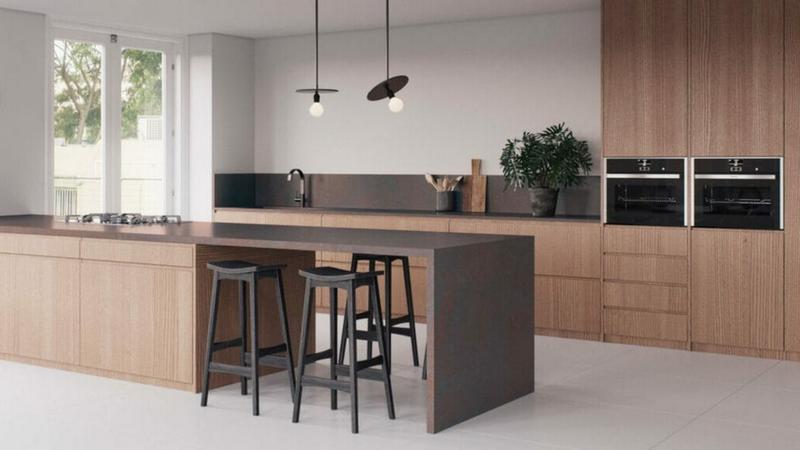
If you want an imposing 5 cm or 7 cm mitered drop edge on a large waterfall island:
- Using a 2 cm base slab saves significant money because you do not pay for thick 3 cm mass in areas where only the outer apron remains visible.
- 2 cm mitered waterfall drops weigh less, reducing mechanical stress on the vertical miter joint where the top meets the side panel.
Transportation and Installation Equipment
3 cm slabs weighing over 800 lbs per slab require 3 to 4 installers or specialized mechanical lifting carts to maneuver through residential doorways safely. In multi-story buildings, narrow stairwells, or elevators with low weight ceilings, hauling 3 cm slabs increases crew labor rates. 2 cm slabs provide a practical, maneuverable alternative that lowers logistical expenses.
Long-Term Value
For standard edge profiles, 3 cm quartz delivers superior return on investment for standard home sales. Prospective buyers perceive solid 3 cm quartz as a premium installation, whereas visible 2 cm profiles with laminated seams can look dated or lower-tier if seams are poorly matched by the fabricator.
Frequently Asked Questions
How thick should countertops be?
▼
Kitchen worktops should measure 3 cm (about 1¼″) for primary prep surfaces and islands. This depth balances structural rigidity with high impact resistance and mounts directly onto cabinets. Bathroom vanity tops can safely measure 2 cm (about ¾″) because they handle lighter daily mechanical stress and shorter spans.
Can 2 cm quartz support an undermount cast iron sink?
▼
Yes, provided installers reinforce the sink cutout properly. Installers must support 2 cm quartz with a solid plywood subtop and use sink harness systems or cradle brackets secured to the cabinet sides. Never hang heavy cast-iron sinks directly from 2 cm quartz rails using basic epoxy clips alone.
What is the thickness of quartz countertops?
▼
Engineered quartz slabs come manufactured in 3 standardized depths: 1.2 cm (~½″), 2 cm (~¾″), and 3 cm (~1¼″). Fabricators can also craft custom edge drop profiles ranging from 4 cm to 10 cm using mitered lamination techniques.
How far can 3 cm quartz overhang without supports?
▼
A 3 cm quartz countertop can safely overhang up to 12″ without corbels or brackets, provided at least 70% of the overall slab rests securely on solid cabinetry. For overhangs measuring 13″ or greater, installers must install heavy-duty steel support plates spaced every 24″ along the seating bar.
Is thicker quartz more expensive?
▼
Yes, a 3 cm raw slab costs 20% to 35% more than a 2 cm slab of identical design. However, finished installation prices for standard edges often balance out. 2 cm installations require extra labor for plywood decking and edge laminations, which narrows the total project cost difference.