
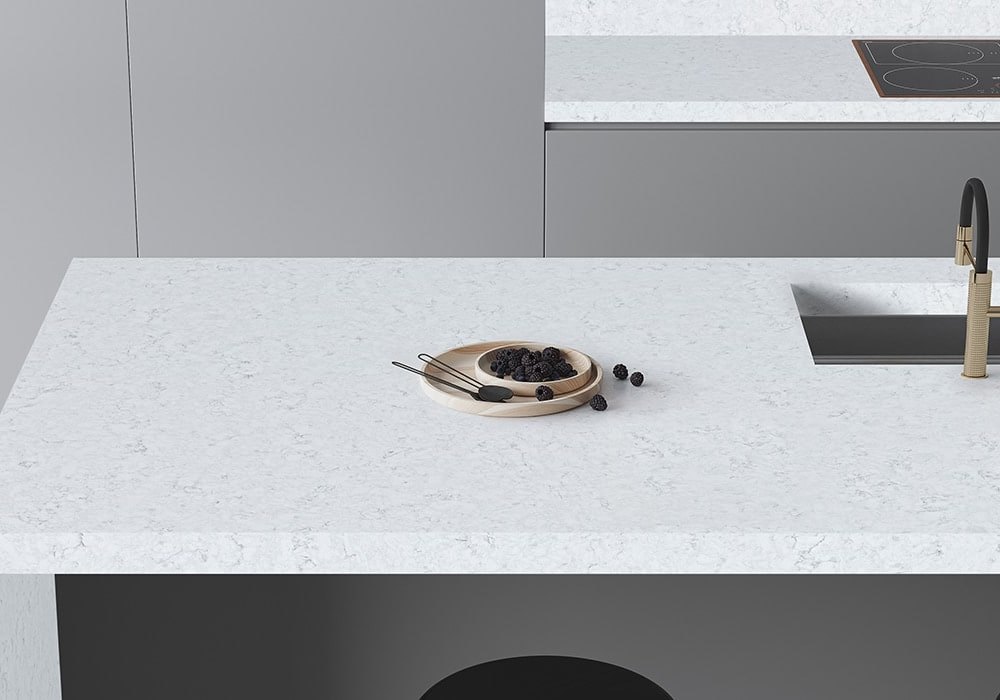
Selecting the right kitchen or bathroom surface comes down to how you live, cook, and maintain your space. Homeowners frequently compare porcelain or quartz countertops because both offer distinct advantages over natural stone like marble and granite.
Quartz provides deep pattern consistency, proven durability, and easy availability. Porcelain offers extreme heat endurance, UV stability, and ultra-thin slab profiles. This guide breaks down cost, performance, fabrication differences, and daily care to help you decide which material fits your remodel best.
What are porcelain and quartz countertops?
Both surfaces are engineered, but their composition and manufacturing processes differ significantly.
Quartz surfaces consist of 90% to 93% crushed natural quartz crystals blended with 7% to 10% polymer resins and color pigments. Manufacturers mix these ingredients, vibrate the slurry in a vacuum press, and cure it with heat. The resulting slab is nonporous, dense, and uniform throughout its entire thickness.
Porcelain surfaces consist of refined kaolin clay, feldspar, silica, and mineral oxides. Manufacturers press these raw minerals under hydraulic pressure exceeding 10,000 psi and fire them in kilns at temperatures above 2,200 °F. This sintering process melts the particles together into a dense glass-like structure. The decorative pattern is applied using high-definition inkjet printing on the surface before or during firing.
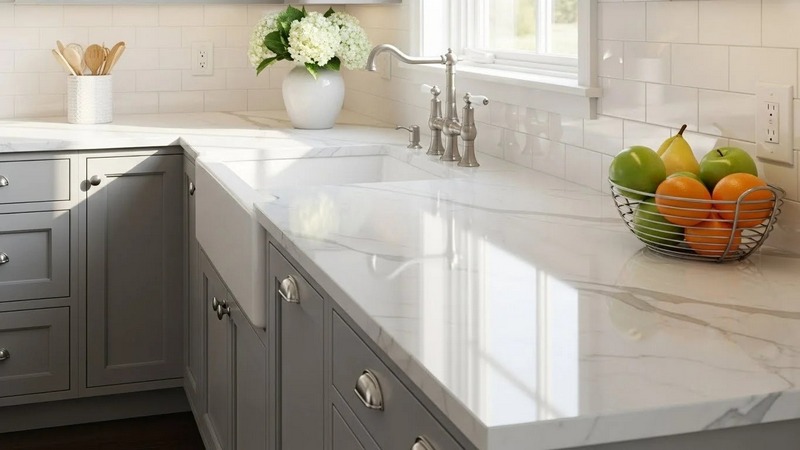
Porcelain vs. Quartz countertops: key differences
When evaluating porcelain vs quartz countertops, key technical specifications show how each surface performs under daily kitchen conditions.
| Feature | Porcelain Countertops | Quartz Countertops |
| Heat Resistance | Tolerates up to 2,000 °F | Tolerates up to 300 °F |
| UV Resistance | 100% UV stable (no fading) | Vulnerable to yellowing and discoloration |
| Scratch Resistance | Mohs hardness 7 to 8 | Mohs hardness 6 to 7 |
| Stain Resistance | Absorption rate under 0.05% | Nonporous resin matrix |
| Seam Visibility | Very fine seams with mitered edges | Standard ¹⁄₁₆″ resin-matched seams |
| Impact Resistance | Prone to edge chipping under blunt force | High impact resistance from flexible resin |
| Average Slab Thickness | 6 mm, 12 mm, 20 mm | 20 mm, 30 mm |
| Outdoor Application | Excellent for outdoor kitchens | Indoor use only |
Understanding these baseline properties helps you evaluate how each surface behaves under pressure. A thorough look at quartz vs porcelain countertops reveals distinct trade-offs between thermal resistance and edge resilience.
Durability & practicality comparison
A successful kitchen renovation requires materials that match your daily habits. Here is how both options handle typical household stresses.
Heat resistance
Porcelain excels in thermal tolerance. Because it forms in kilns above 2,200 °F, thermal shock does not damage the surface. You can transfer boiling pots, baking sheets, and cast-iron skillets straight from the stovetop to a porcelain slab without trivets.
Quartz contains polyester and acrylic resins that melt, scorch, or discolor when exposed to rapid temperature changes. Heat above 300 °F breaks down these polymer bonds, leaving permanent white rings or cloudy marks. Trivets and hot pads are mandatory for quartz surfaces.
Scratch & stain resistance
Both materials deliver exceptional protection against household spills:
- Porcelain surfaces register 7 to 8 on the Mohs hardness scale. Kitchen knives, ceramic dishware, and steel cutlery will not scratch the glaze or body. The nonporous matrix prevents red wine, turmeric, coffee, and cooking oils from penetrating.
- Quartz surfaces score 6 to 7 on the Mohs scale. Quartz resists everyday wear, but dragging heavy metal cookware across the surface can leave gray transfer marks. The resin binder creates a sealed barrier that stops liquid penetration without topical sealers.
Porcelain holds a slight edge against harsh chemicals. You can clean porcelain with acidic or bleach-based cleaners without damaging the finish. In contrast, quartz reacts poorly to high-pH chemicals, paint removers, and caustic oven cleaners, which strip the resin finish.
Outdoor & UV exposure
If you are planning an outdoor kitchen or a patio prep station, porcelain is the superior choice. Porcelain pigments undergo ceramic vitrification, making them impervious to ultraviolet radiation. The color will not fade, yellow, or warp under continuous sun exposure, freeze-thaw cycles, or rain.
Quartz is unsuitable for outdoor installations. Direct sunlight degrades the polymer resins, causing dark colors to fade and white slabs to take on a yellowish tint within 12 to 24 months. Temperature swings also cause resin expansion, leading to structural cracks along joints.
Maintenance & care
Routine cleaning is straightforward for both options:
- Daily wipe-downs: Warm water and mild dish soap applied with a microfiber cloth remove 95% of daily kitchen grease and debris on both surfaces.
- Sealing requirements: Neither material requires annual sealing, wax treatments, or specialized conditioning agents.
- Stubborn residues: For dried food crusts on quartz, use a nonabrasive sponge with a pH-neutral cleaner. For porcelain, you can use heavy-duty degreasers, vinegar solutions, or abrasive scrubbing pads without dulling the polished or matte finish.
When deciding between a porcelain countertop vs quartz for high-traffic kitchens, keep in mind that porcelain handles chemical spills and direct heat with less supervision, while quartz offers greater resistance against accidental edge impacts from heavy pots.
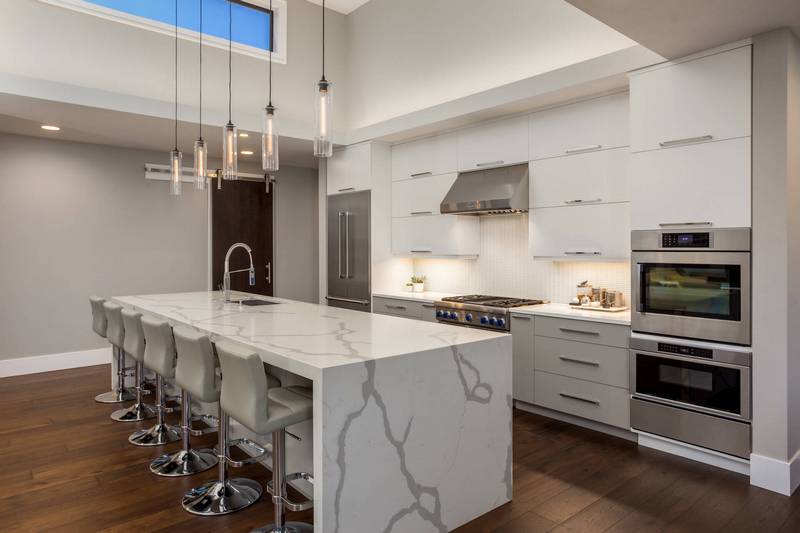
Porcelain countertops price vs. Quartz (cost breakdown)
The overall project budget depends on material quality, slab dimensions, edge profile complexity, and local fabrication requirements. Looking closely at porcelain countertops price vs quartz, raw material costs are relatively comparable, while specialized fabrication labor creates the primary pricing difference.
| Expense Category | Porcelain Countertops (per sq ft) | Quartz Countertops (per sq ft) |
| Raw Material Only | $20 to $65 | $20 to $65 |
| Fabrication & Installation Labor | $65 to $130 | $50 to $90 |
| Total Installed Price | $95 to $200 | $75 to $155 |
Cost evaluating requires factoring in fabrication complexity. Quartz is dense and easily cut with standard bridge saws and diamond waterjet cutters. Standard 2 cm and 3 cm quartz slabs require predictable labor, keeping installation costs between $50 and $90 per sq ft.
Porcelain slabs hold higher internal tension. Fabricators must use specialized diamond blades with continuous water cooling and reduced cutting speeds to prevent stress fractures. Creating laminated or mitered edge profiles to give thin 6 mm or 12 mm porcelain slabs a 2″ or 3″ appearance demands precision cutting, which elevates labor rates to $65 to $130 per sq ft.
Because of this specialized fabrication requirement, are porcelain countertops cheaper than quartz across standard residential projects? Generally, no. Even though raw porcelain slabs start around $20 to $25 per sq ft (such as 52 sq ft slabs starting near $1,114), the finished, installed surface typically costs more due to the precision fabrication and handling required.
Aesthetics and design options
Both surfaces offer diverse aesthetic options for modern, traditional, and transitional homes:
- Porcelain aesthetics: High-resolution digital printing reproduces the exact veining, crystalline depth, and color variation of rare Italian marbles like Calacatta Gold and Statuario, as well as concrete and oxidized metals. Slabs are available in polished, matte, satin, and textured finishes. The main aesthetic limitation involves edge profiles. The printed pattern on many porcelain slabs sits on the top layer, meaning standard bevel or bullnose cuts reveal the solid base color underneath. To hide this, fabricators use 45-degree mitered apron edges. Through-body porcelain slabs with full-depth veining exist, but carry a premium price tag.
- Quartz aesthetics: Modern quartz manufacturing creates intricate veining patterns that run through the entire thickness of the 20 mm or 30 mm slab. When the fabricator cuts an ogee, bullnose, or beveled edge, the veins remain visible throughout the cut. Quartz is available in hundreds of colors, from solid pure whites and deep blacks to flecked terrazzo styles. Quartz slabs are offered in polished, honed, and textured leather finishes.
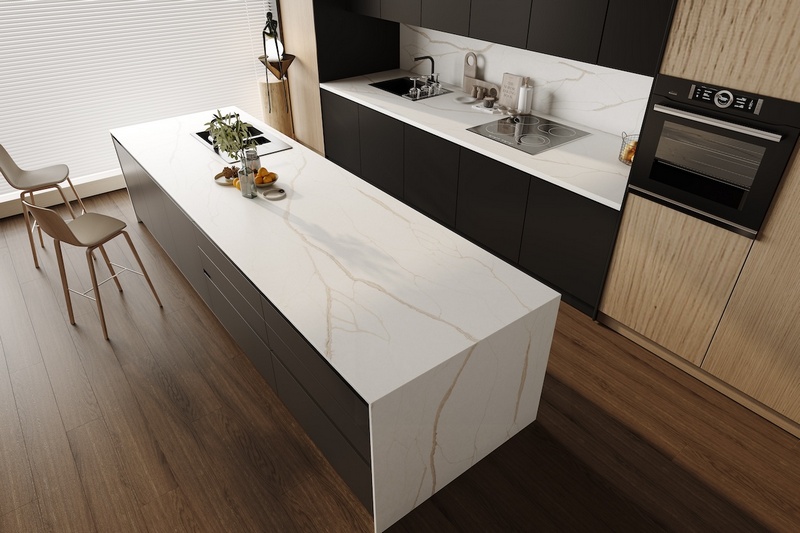
Pros and cons summary
Review this side-by-side summary to weigh the practical trade-offs of each material before purchasing.
Porcelain Pros:
- Withstands temperatures up to 2,000 °F without scorching
- Completely immune to UV rays and outdoor weather
- Nonporous surface resists stains, acids, and harsh chemicals
- Available in large slab formats that reduce the number of seams
- Lightweight 6 mm and 12 mm slabs work well for wall cladding and backsplashes
Porcelain Cons:
- Porcelain slab vs quartz cost is higher, as well as installation and fabrication costs
- Edges are vulnerable to chipping from heavy impacts
- Pattern is often surface-printed rather than through-body
- Requires fabricators with specialized certification and tooling
Quartz Pros:
- Wide availability of certified fabricators keeps labor costs lower
- High impact resistance reduces the risk of edge chipping
- Full-body patterns carry consistent veining through all edge profiles
- Uniform slab composition ensures consistent color matching across seams
- Completely nonporous surface requires zero periodic sealing
Quartz Cons:
- Vulnerable to heat damage from pans above 300 °F
- Resin yellows and degrades when exposed to UV light
- Cannot be installed in outdoor kitchens or sunrooms
- Heavier 30 mm slabs require sturdy structural cabinet support.
Frequently Asked Questions
Can you set hot pans directly on porcelain vs. quartz?
▼
Can chipped edges on porcelain and quartz be repaired?
▼
Which material requires more maintenance: porcelain or quartz?
▼
What slab thickness should I choose for kitchen countertops?
▼
How do porcelain vs. quartz countertop costs compare per square foot?
▼