
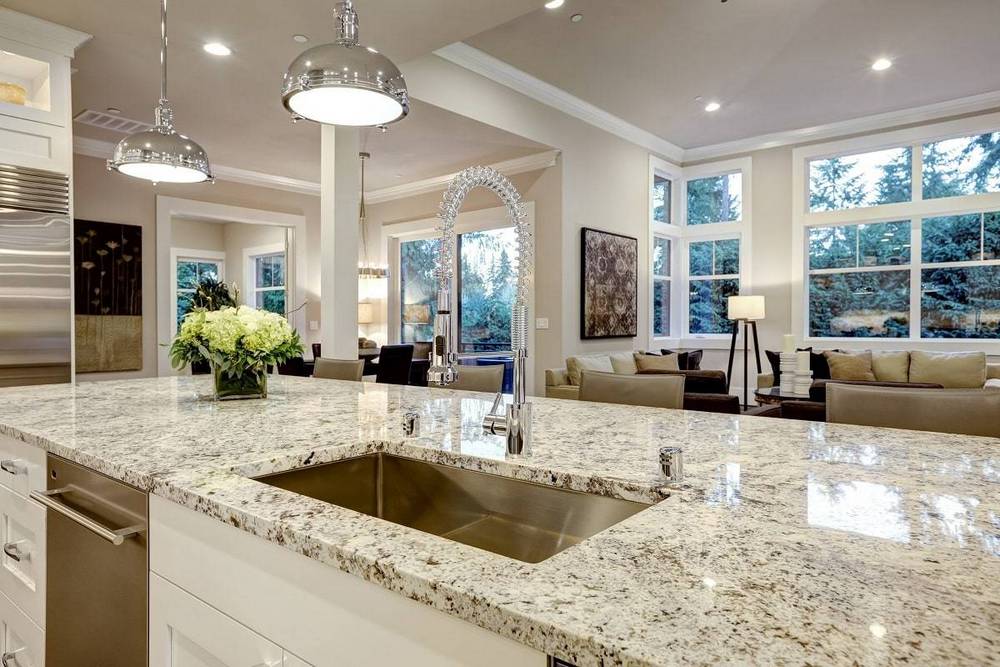
Quartz surfaces are engineered for durability, stain resistance, and a clean modern aesthetic. Over time, daily wear, improper cleaners, and grease buildup can create a dull film on your kitchen counters. Learning the correct techniques for polishing quartz countertops allows you to restore that factory finish without compromising the resin binders inside the engineered slab.
Can you Polish quartz countertops?
Homeowners often ask: can you polish quartz countertops using standard stone care tools? The short answer is yes, but the process is different from natural stone like marble or granite.
Quartz consists of 90% to 93% crushed natural quartz minerals bound together with 7% to 10% polymer resins and pigments. Because of this resin matrix, standard high-friction polishing pads and harsh diamond abrasives will melt or scorch the surface. You must distinguish between routine topical cleaning or light buffing and structural stone restoration.For deep restoration, specialized diamond pads with water cooling are mandatory to protect the resin from heat degradation.
Why quartz countertops lose their shine
Engineered stone surfaces rarely lose their gloss due to wear on the quartz mineral itself. Instead, the loss of luster happens on the resin layer or from topical contamination.
Common causes include:
- Hard water mineral deposits: Calcium and magnesium in tap water leave a cloudy chalky film near sinks.
- Chemical damage from harsh cleaners: Bleach, oven cleaners, acidic degreasers, and high pH soaps (pH over 10) chemically etch the resin binder.
- Heat haze: Placing hot pots or pans directly on the counter transfers heat above 300°F (149°C), scorching the resin.
- Grease and soap residue buildup: Cooking oils and dish soap form an invisible layer that traps dust and makes quartz countertops not shiny.
- Abrasive scour pads: Using green scouring pads or steel wool creates micro-scratches that scatter light instead of reflecting it.
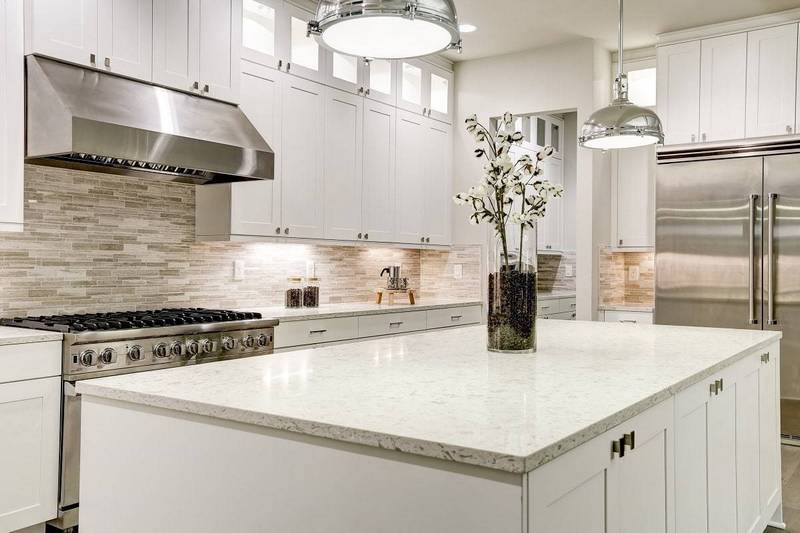
What you need to Polish quartz countertops
Before starting, gather the right equipment. Using the wrong products can cause permanent surface hazing.
Required tools and materials:
- pH-neutral stone soap or mild dish detergent
- Microfiber cloths (at least 4 to 5 clean cloths)
- Distilled water in a spray bottle
- Isopropyl alcohol (70% concentration)
- Non-abrasive cleaning sponge
- Specialized quartz countertop polish formulated for engineered stone
- Variable-speed polisher with wet diamond pads (grit 400, 800, 1500, 3000) for edge repairs
- Soft buffing pad attachment for electric drill or random orbital polisher
- Clean plastic putty knife or razor blade for removing dried debris
How to Polish quartz countertops at home
Follow this step-by-step procedure to eliminate haze and restore your surface cleanly.
Step 1: Deep Surface Cleaning and Debris Removal
Clear the entire counter. Spray the surface with a solution of warm water and 2 to 3 drops of pH-neutral soap. Allow it to sit for 3 min to break down surface oils. Hold a flexible plastic putty knife at a 45-degree angle to scrape away dried paint, glue, or food residue. Wipe the area clean using a damp microfiber cloth.
Step 2: Degreasing and Surface Decontamination
Mix 50% isopropyl alcohol and 50% distilled water in a spray bottle. Spray the mixture evenly across the slab. This solution cuts through stubborn cooking grease and dissolves cleaning film without requiring costly slab refinishing. Wipe dry with a clean microfiber towel in circular motions.
Step 3: Spot Treating Etched and Stained Spots
If specific sections remain dull, create a paste using baking soda and water. Apply the paste directly to the dull area. Let it sit for 5 to 10 min. Gently rub the paste with a soft sponge, applying light pressure. Rinse thoroughly with distilled water and dry with a fresh towel.
Step 4: Applying Surface Polish
Can quartz be polished? Apply a specialized non-abrasive engineered stone treatment spray to refresh the gloss. Work in small sections of 3 ft by 3 ft. Spread the product evenly across the quartz with a clean cloth. Let the formula penetrate for 2 min according to the product guidelines.
Step 5: Buffing the Countertop
Using a fresh microfiber cloth or a variable-speed buffer fitted with a soft microfiber bonnet set under 1000 RPM, buff the surface in overlapping circular patterns. Continue buffing until the product disappears and a smooth, reflective luster emerges. This process eliminates haze without damaging the underlying resin.
How to make quartz countertops shine
Beyond corrective cleaning, maintaining a long-lasting gloss requires a consistent care routine. Knowing how to make quartz countertops shine comes down to daily prevention and the right maintenance protocols.
- Clean spills immediately: Acidic substances like tomato sauce, coffee, wine, and citrus juice should be wiped up within 2 min to prevent chemical haze.
- Use distilled water for final wiping: Tap water leaves microscopic mineral rings when it evaporates. Distilled water keeps the quartz crystal clear.
- Avoid silicone-based sealers: Standard granite sealers do not absorb into engineered stone. They sit on top, dry unevenly, and create a cloudy film.
- Protect from UV exposure: Direct sunlight degrades the polymer resin, causing yellowing and surface cloudiness.
- Use cutting boards and trivets: Prevent mechanical scratches and thermal shock by keeping hot kitchenware and sharp blades off the surface.
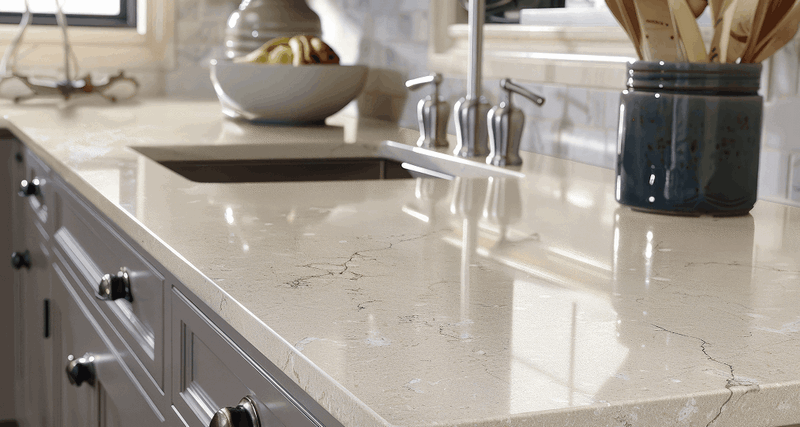
How to Polish quartz countertops after cutting
When fabricating, cutting a sink hole, or trimming edges, the exposed stone profile requires multi-step wet polishing to match the factory top gloss.
Follow this process on how to polish quartz countertops after cutting:
- Safety preparation: Secure the slab with clamps. Wear safety glasses, an N95 or P100 respirator mask to protect against respirable crystalline silica dust, and waterproof gloves.
- Wet grinding with 50-grit to 100-grit pads: Attach a 50-grit wet diamond pad to a variable-speed wet polisher running at 2000 RPM. Apply continuous water feed to cool the stone. Smooth down the rough blade marks along the cut edge.
- Intermediate smoothing with 200-grit to 400-grit pads: Move to 200-grit, followed by 400-grit. Keep the tool moving steadily to prevent uneven gouges or localized heat buildup.
- Pre-polishing with 800-grit to 1500-grit pads: Switch to 800-grit and then 1500-grit pads. Water flow must remain steady. At 1500-grit, the edge will begin to show a semi-gloss sheen.
- Final high-gloss wet polishing with 3000-grit pad: Run the 3000-grit pad at 1500 RPM with moderate water. This step brings the cut edge up to a high-gloss factory match.
- Edge buffing with diamond compound: Finish the edge with an engineered stone buffing pad and aluminum oxide or cerium oxide polishing paste. Run at low speed (1000 RPM) with light pressure to achieve a mirror finish.
Quartz countertop polishing: common mistakes
Avoid these widespread errors when learning how to polish quartz countertops:
- Using dry diamond pads: Dry friction creates heat exceeding 200°F (93°C), which scorches the polymer resin and leaves permanent brown burn marks.
- Applying abrasive powder cleaners: Cleaners with pumice, quartz powder, or bleach scratch the resin binder and permanently dull the finish.
- Full-surface mechanical resurfacing: Trying to sand the flat factory top of a quartz slab with an orbital sander creates uneven depressions and ruins the uniform gloss. Leave full slab repairs to professional fabricators.
- Applying wax or topical sealers: Wax attracts grime, yellows over time, and smudges easily.
- High-RPM rotary tools: Running polishers above 3000 RPM overheats the stone and creates swirls in the resin matrix.
Frequently Asked Questions
Can you buff quartz countertops?
▼
Can you use granite polish on quartz surfaces?
▼
How to restore shine to quartz countertops?
▼
What should you do if quartz has heat burn marks?
▼
Does quartz need to be polished?
▼