
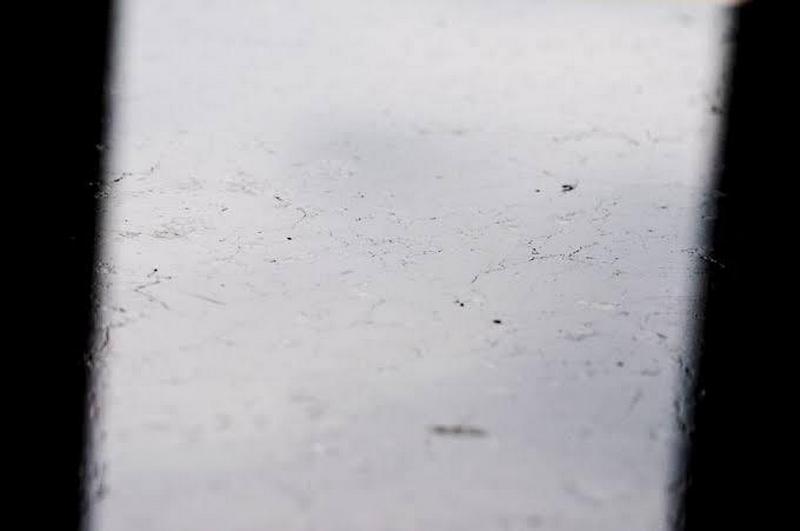
Natural granite surfaces handle heat, knives, and daily kitchen work better than most materials. Even so, small pockets, rough divots, and flecks sometimes pop out of the surface.
Homeowners often worry that these small holes mean their stone is cracking or falling apart. In reality, pitted granite countertops are a standard feature of natural igneous rock and can be repaired at home in under 1 hr.
What are pits in granite countertops?
Granite forms deep underground as molten magma cools slowly under intense pressure. This geological process fuses several distinct minerals together, including quartz, feldspar, mica, and hornblende. Each mineral brings a different level of hardness to the slab.
Quartz rates at 7 on the Mohs hardness scale, while feldspar rates at 6. Biotite mica, by contrast, rates between 2.5 and 3. Biotite appears as dark, reflective flakes within the stone matrix. Because mica is much softer than surrounding quartz crystals, tiny flakes can detach during factory fabrication or routine kitchen use.
When a soft mineral pocket releases, it leaves behind a pinhead-sized void. A void of this type is what homeowners recognize as pits in granite countertop surfaces. These indentations typically measure between 1 mm and 3 mm across.
Pitting is structurally distinct from other stone issues:
- Pits: Small, shallow surface craters caused by dislodged mineral grains, usually mica or hornblende.
- Fissures: Natural, hairline separations that follow mineral boundaries throughout the slab depth. Fissures do not affect structural integrity and do not catch a fingernail like a crack does.
- Cracks: Structural fractures caused by improper slab leveling, heavy impact, or cabinet settling. Cracks run deep and require professional mechanical stabilization.
- Etches: Dull spots created by chemical reactions when acids dissolve calcium minerals or surface sealers, leaving the stone looking cloudy rather than physically cratered.
Most pits never expand past the boundary of the dislodged mineral crystal. They do not compromise the slab or signal that the stone will snap. They simply catch crumbs, collect cleaning fluid, and interrupt an otherwise smooth finish.
Common causes of granite pitting
Granite does not pit because of poor fabrication alone. While factory processing plays a role, daily household routines, thermal fluctuations, and mineral composition also contribute to missing flecks over time.
- Geological mineral composition
Slabs with high concentrations of biotite, muscovite, or amphibole pit more frequently than dense, fine-grained granites. As the slab is cut with diamond gang saws and polished with abrasive diamond pads, softer crystals take on microscopic stress fractures. Some grains loosen during fabrication, while others remain barely anchored until daily friction dislodges them. - Heavy mechanical impact
Granite is rigid and brittle. Dropping a heavy cast-iron skillet, ceramic mug, or glass jar onto the surface creates concentrated point stress. Even if the impact does not crack the slab, it can shatter a brittle feldspar or mica cluster, causing it to fall out instantly. - Improper cleaning products
Harsh chemicals erode the natural bonds around softer minerals. Acidic liquids like vinegar, lemon juice, wine, and tomato sauce weaken weak mineral pockets if left standing. Caustic cleaners such as bleach or ammonia break down topical stone treatments and penetrate unsealed pores, accelerating crystal loss. - Thermal shock
Granite resists heat well, but placing 450°F roasting pans directly onto cold granite causes localized thermal expansion. The quartz and feldspar expand at different rates. That internal expansion puts shear stress on adjacent mica flakes, eventually popping them loose from the top layer. - High-wear friction zones
Pits appear most often around kitchen sinks, prep zones, and island seating areas. Belt buckles rubbing against the edge, cutting boards sliding across uncleaned grit, and pots bumping the sink cutout provide the continuous abrasive force needed to loosen vulnerable minerals.
How to fix pits in a granite countertop
Fixing surface divots does not require an expensive service call. Learning how to fix pits in granite countertop slabs takes basic household supplies and 30 min of active working time.
Follow this 6-step process to restore a smooth, level finish:
- Clean the repair zone thoroughly
Strip away grease, cooking oils, and dust trapped inside the crater. Spray the area with 91% or 99% isopropyl alcohol and scrub the pit using a clean, soft-bristled toothbrush. Wipe the stone completely dry with a lint-free microfiber towel. Wait 15 min to make sure all residual alcohol evaporates out of the stone pores. - Mask the perimeter
Tear 4 small strips of blue painter tape. Place the tape around the pit, leaving only a 1 mm border of exposed stone around the crater. This tape dam protects the polished factory finish from accidental adhesive overflow and scraper marks. - Apply the filler material
Select a low-viscosity clear cyanoacrylate adhesive or a light-curing acrylic repair gel. Deposit 1 drop directly into the center of the pit. Fill the pit until the resin mounded slightly above the surrounding surface plane. Surface tension will pull the liquid into microscopic voids, and the filler will shrink slightly as it cures, making a slight overfill necessary. - Cure the repair
For clear cyanoacrylate, spray a light mist of aerosol adhesive activator over the repair from 12 in away, or allow it to cure naturally for 3 hr. If using a light-curing acrylic, place a clear curing strip over the drop to flatten it, then hold a 400 nm blue light directly over the repair for 60 sec. - Scrape flush with a fresh razor blade
Remove the painter tape. Hold a new, single-edge steel razor blade at a 45-degree angle against the counter surface. Apply light, even downward pressure and slide the blade smoothly across the raised bead in 1 direction. Do not tilt the blade corners into the stone, which could scratch the polished feldspar. Shave the adhesive down until your fingertips cannot feel a seam between the cured resin and the granite. - Polish and buff the repair
Apply a dime-sized dab of non-abrasive granite polishing paste or automotive swirl remover over the patch. Buff the area in tight circular motions using a clean microfiber cloth for 2 min. Clean the surface with stone cleaner to inspect the repair under angled light. The pit should be completely transparent and flush with the countertop.
What can you use to fill pits in granite countertops?
Choosing the right compound depends on the pit depth, color of the stone, and how quickly you need to use the counter. Homeowners looking into how to fill pits in granite countertop areas successfully rely on 4 main materials:
- Clear cyanoacrylate (Super Glue)
Clear cyanoacrylate works well for shallow pits under 2 mm deep and 3 mm wide. The clear liquid reflects light the same way the surrounding quartz crystals do, adopting the natural color of the rock beneath it. Gel versions are easier to control on bevels, while thin liquid formulas penetrate deeper into porous voids. - Two-part clear epoxy resin
For pits larger than 3 mm wide or deeper than 3 mm, 2-part epoxy offers superior tensile strength and adhesion. Epoxy consists of a resin and hardener mixed at a 1:1 ratio. It resists moisture, handles hot items nearby, and does not shrink noticeably as it sets. Epoxy requires 24 hr to cure fully before razor scraping and buffing. - Light-curing acrylic (LCA)
LCA kits are among the most popular DIY options for granite maintenance. These acrylic polymers remain workable indefinitely until exposed to a high-intensity curing light. LCA does not yellow over time when exposed to direct sunlight through kitchen windows, making it suitable for white and light-gray stone. - Tinted polyester stone adhesive
Fabricators use polyester pastes to join seams and fill large gouges. These adhesives can be color-matched using mineral oxide pigments to match specific granite colors such as Uba Tuba, Absolute Black, or Baltic Brown. Polyester cures hard in 20 min but requires precise mixing with a paste hardener.
Material comparison breakdown:
- Clear Cyanoacrylate: 5 min cure time, excellent clarity, best for pinhead pits under 2 mm.
- Two-Part Epoxy: 24 hr cure time, high bond strength, best for deep chips and impact gouges.
- Light-Curing Acrylic: 1 min cure time under LED, UV stable, best for light-colored counters.
- Polyester Paste: 20 min cure time, color customizable, best for opaque fills on dark stone.
Can you prevent pits in granite countertops?
You cannot alter the geological makeup of natural stone, but you can prevent soft minerals from loosening prematurely. Simple kitchen habits keep granite smooth for decades:
- Use cutting boards for all kitchen prep
Never chop food directly on granite. Knives scratch softer mica inclusions and force thin vegetable juices into microscopic mineral pockets. Chopping vibrations also loosen semi-attached grains. - Protect high-impact zones
Place rubber-backed mats or silicone pads near sink rims and dishwasher loading zones. Cast-iron pans, heavy stoneware, and stainless steel utensils striking the counter rim cause most edge pitting. - Clean with pH-neutral stone detergents
Avoid all-purpose cleaners containing vinegar, citrus extracts, ammonia, or bleach. Use dedicated stone soaps or warm water mixed with mild, degreasing dish soap. Neutral cleaners clean food oils without breaking down the mineral binders. - Apply penetrating sealer regularly
Penetrating sealers do not fill pits or make stone scratch-proof. However, they soak into open capillaries to repel water, wine, and cooking oils. Preventing liquids from sitting inside mineral voids stops the slow expansion and chemical degradation that forces surface mica out. Apply one coat of impregnating sealer every 12 months, or whenever water stops beading on the surface within 5 min. - Handle hot cookware with trivets
Do not set pots straight from the burner onto the granite slab. Thermal shock causes uneven expansion between mica and quartz crystals, creating stress cracks that pop out as visible craters over time.
Frequently Asked Questions
How to repair pits in granite countertop?
▼
Will pitting weaken the granite slab structure?
▼
Why does my granite always feel gritty?
▼
Does sealing stop granite from chipping or pitting?
▼
Is granite always speckled?
▼