
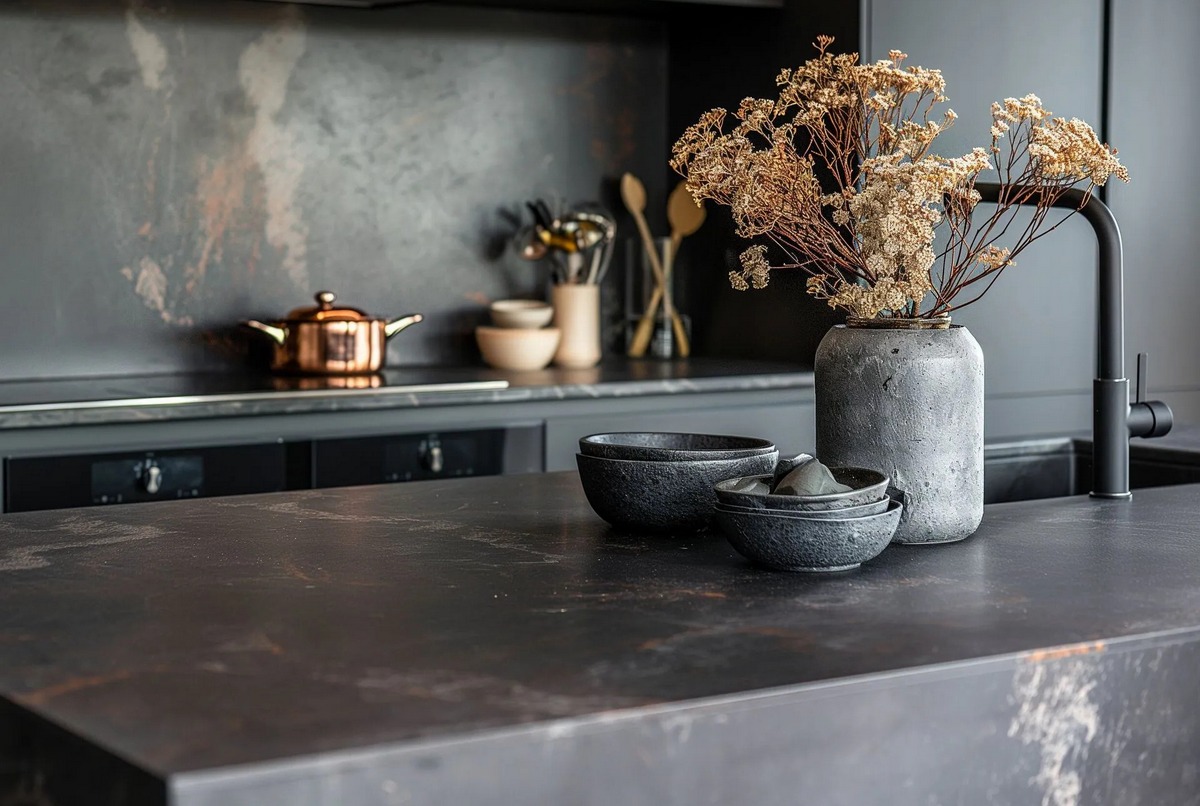
Granite’s finish affects its color, reflections, and how everyday marks appear. Polished surfaces offer a glossy look, while honed surfaces have a softer, matte appearance. Comparing polished vs honed granite means deciding which look and cleaning routine suit your kitchen, not simply choosing between shiny and dull.
What is polished granite?
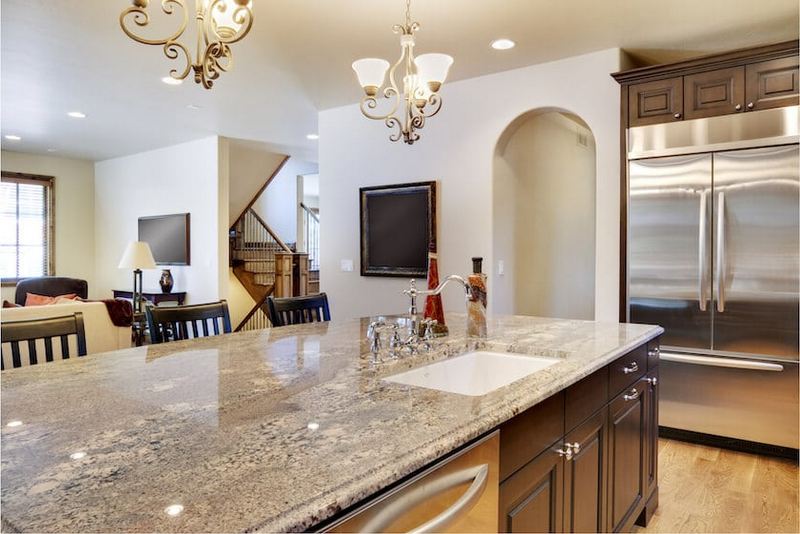
Polished granite has a smooth, reflective surface created with progressively finer abrasives. The process brings out mineral patterns and makes colors appear richer.
The shine comes from mechanically refining the surface, rather than applying a glossy coating. Properly finished granite can retain its appearance for years with suitable care. Sealing serves a different purpose: it helps reduce absorption where the material needs additional stain protection.
A polished black countertop may look deep and mirrorlike, while a lighter variety shows clearer mineral contrast. Under pendant lights, reflections can become prominent. View samples horizontally because an upright showroom display catches light differently from a kitchen counter.
Polishing does not make granite indestructible or automatically eliminate sealing needs. Its absorption, existing treatments, and intended use still matter. Ask your fabricator for care instructions specific to your selection.
What is honed granite?
Honing creates a smooth surface with little reflection. Fabricators stop the abrasive finishing process before achieving a high gloss.
So, what is honed granite? The simplest answer is granite finished to a matte or satin appearance. It feels smooth rather than rugged. Depending on the variety, its color may appear lighter or more muted than the polished version.
Retail descriptions sometimes call this a matte finish, but that does not mean the countertop is raw or unfinished. It has undergone deliberate surface preparation. A honed countertop also differs from leathered granite, which has a textured surface.
Ask to see the actual slab before approving fabrication. Small samples may miss broad color changes, mineral clusters, or movement across the surface. Review the proposed finish on a representative piece whenever possible.
Honed granite vs polished granite: side-by-side comparison
The same material can look noticeably different after finishing. Compare matching samples under the lighting you use at home.
When weighing honed granite vs polished granite, consider visible marks alongside appearance. Neither option changes the underlying material into a different product. Both still need appropriate support, careful fabrication, and protection from damaging impacts.
| Feature | Polished finish | Honed finish |
| Appearance | Glossy with distinct reflections | Matte or satin with reduced reflections |
| Color | Usually richer and more pronounced | Often softer or more muted |
| Surface feel | Smooth | Smooth, sometimes velvety |
| Glare | More noticeable under direct lighting | Less noticeable under direct lighting |
| Visible marks | Water spots and streaks can stand out | Oily marks can stand out, especially on dark colors |
| Fine scratches | May interrupt the reflective surface | Often blend into the surrounding finish |
| Sealing | Depends on absorption and existing treatment | Requires assessment; some selections need closer attention |
| Availability | Commonly stocked | May require special ordering or additional finishing |
| Price | Often the standard finish price | May cost more when extra processing is required |
There is no universal price difference that applies to every project. Material availability, edge details, cutouts, transportation, and installation all affect the quote. Compare estimates with identical specifications before attributing a higher total to the finish alone.
Pros and cons of polished granite
Pros
Polishing brings mineral details into sharper view. If you chose granite for its crystalline sparkle or contrasting colors, this finish usually makes those characteristics more prominent.
For a patterned kitchen island, that clarity can make the countertop the room’s main visual feature. A quieter cabinet color gives the pattern space. Reflected light also contributes brightness around the work area, although it cannot replace adequate task lighting.
In a honed granite vs polished comparison, polished surfaces often appeal to homeowners who want vivid color and straightforward daily wiping. Their smooth finish makes routine cleanup convenient. A soft cloth, suitable cleaner, and thorough drying generally handle ordinary residue.
Practical advantages include:
- Stronger visual contrast between minerals.
- Broad availability across common granite selections.
- A smooth surface for removing crumbs and spills.
- Compatibility with traditional and contemporary cabinetry.
Because polishing is a common factory finish, it may also simplify sourcing. Ask whether the quoted material arrives ready for fabrication or needs additional processing.
Cons
Reflections can become distracting beneath exposed bulbs or beside large windows. Before ordering, examine a sample where sunlight crosses your counter. Check it again with the kitchen lights switched on after dark.
Gloss also makes certain marks easier to notice. Dried droplets, cleaner residue, and fine scratches may interrupt an otherwise consistent reflection. Dark, relatively uniform colors can reveal these changes more clearly than busy patterns.
The difference between honed and polished is especially noticeable when light falls across the surface at a shallow angle. A mark that disappears from above may become obvious from a seated position. That matters if your island doubles as a dining area.
Polished granite still needs cutting boards and trivets. Its hardness does not protect every edge from chipping, and sudden temperature changes can cause damage. Avoid dragging heavy cookware across the counter.
Pros and cons of honed granite
Pros
Honed surfaces soften reflections without adding a pronounced texture. They can work well beside glossy tile, glass cabinets, or metallic fixtures when you want fewer competing highlights.
A honed finish on granite also makes some fine scratches less noticeable because there is no sharp reflection for them to interrupt. This can help a frequently used counter look more consistent. Deeper scratches, chips, and stains will still remain visible.
The matte appearance suits kitchens with wood cabinets, muted paint, and brushed hardware. It can also give dark granite a quieter presence in a bright room. The result depends on the actual color and pattern, so avoid choosing from a finish name alone.
Natural stone contains variations that remain part of the countertop after honing. Some minerals may reflect more light than others. Review a finished sample to understand whether the slight variation is acceptable to you.
Cons
Matte does not automatically mean easy to keep looking clean. On some dark varieties of unpolished granite, cooking oil and fingerprints leave noticeable darker patches. These may be surface residue, absorbed oil, or temporary moisture darkening, each requiring a different response.
Honing can also change how a particular granite absorbs liquids. Ask the fabricator to assess stain protection rather than assuming every honed surface needs the same treatment. Follow the selected sealer’s instructions instead of adopting a fixed resealing schedule.
Color deserves attention too. A black sample may appear charcoal after honing, and subtle patterns can become less distinct. A color enhancer may deepen the appearance, but it should be tested before application because the change can be difficult to reverse.
Availability may narrow your options. If your chosen material comes only polished, additional processing can increase cost and lead time. Confirm that exposed edges, sink details, and the main surface will have a consistent finish.
Honed or polished granite: which should you choose?
Start with the marks that bother you most in your current kitchen. Then consider how much direct light reaches the countertop.
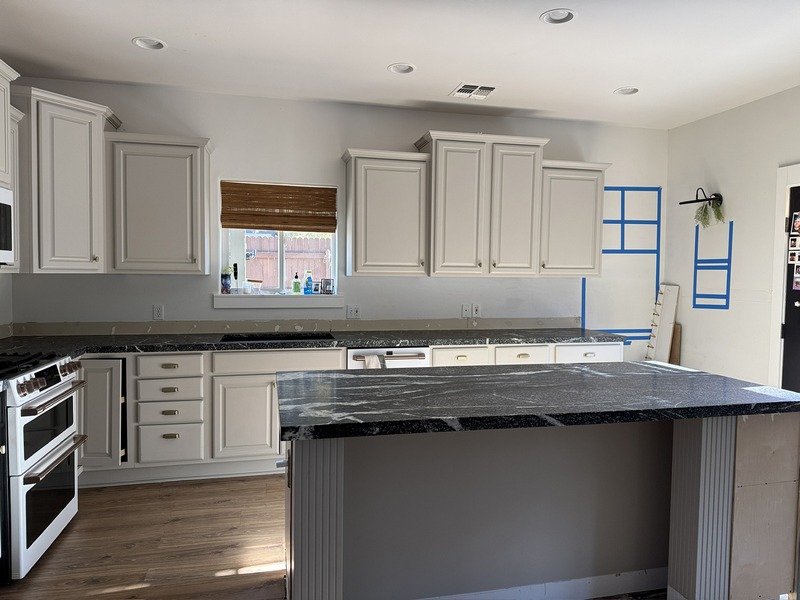
Choosing honed or polished granite becomes easier when you compare finished samples rather than isolated photographs. Camera exposure can exaggerate shine or hide oily patches. Your own lighting provides a more useful test.
Choose polished if rich color and crisp mineral detail are priorities. It is also worth considering when you want a commonly available finish without additional processing. Check whether reflections from windows or pendant lights will be comfortable.
Choose honed if you prefer subdued color and less glare. Be prepared to assess how your chosen variety shows grease and fingerprints. A lighter, patterned option may behave differently from a uniform black surface.
Use this process before approving your order:
- Compare matching samples. Use the same granite variety so differences in color or mineral structure do not distort the comparison.
- Check your lighting. Examine each sample in daylight and under evening lighting, both standing and seated.
- Review cleaning behavior. With the supplier’s permission, test an offcut for fingerprints and ordinary kitchen residue, then clean it as directed.
- Confirm treatment. Ask which sealer, if any, is recommended and whether it changes the appearance.
- Compare complete quotes. Include finishing, edges, cutouts, installation, and any additional processing time.
For either finish, blot spills promptly and clean with a suitable neutral cleaner or mild detergent as recommended. Rinse away residue and dry with a soft cloth. Excess cleaner can leave a film that looks like a surface problem.
Discuss finish changes before fabrication whenever possible. Refinishing an installed counter involves access limitations, protection for surrounding surfaces, and careful treatment around edges. Choosing correctly at the outset avoids that additional work.
Luxiomer offers countertop sourcing, fabrication, and installation for Los Angeles projects. Bring cabinet colors, kitchen photos, and approximate dimensions when discussing your selection. Request a project estimate that identifies the material and finish clearly.
Frequently Asked Questions
What does honed granite mean?
▼
Does either finish need sealing every year?
▼
Can you hone granite after install?
▼
Which finish is better for a busy family kitchen?
▼
Can honed granite be polished?
▼
“`