
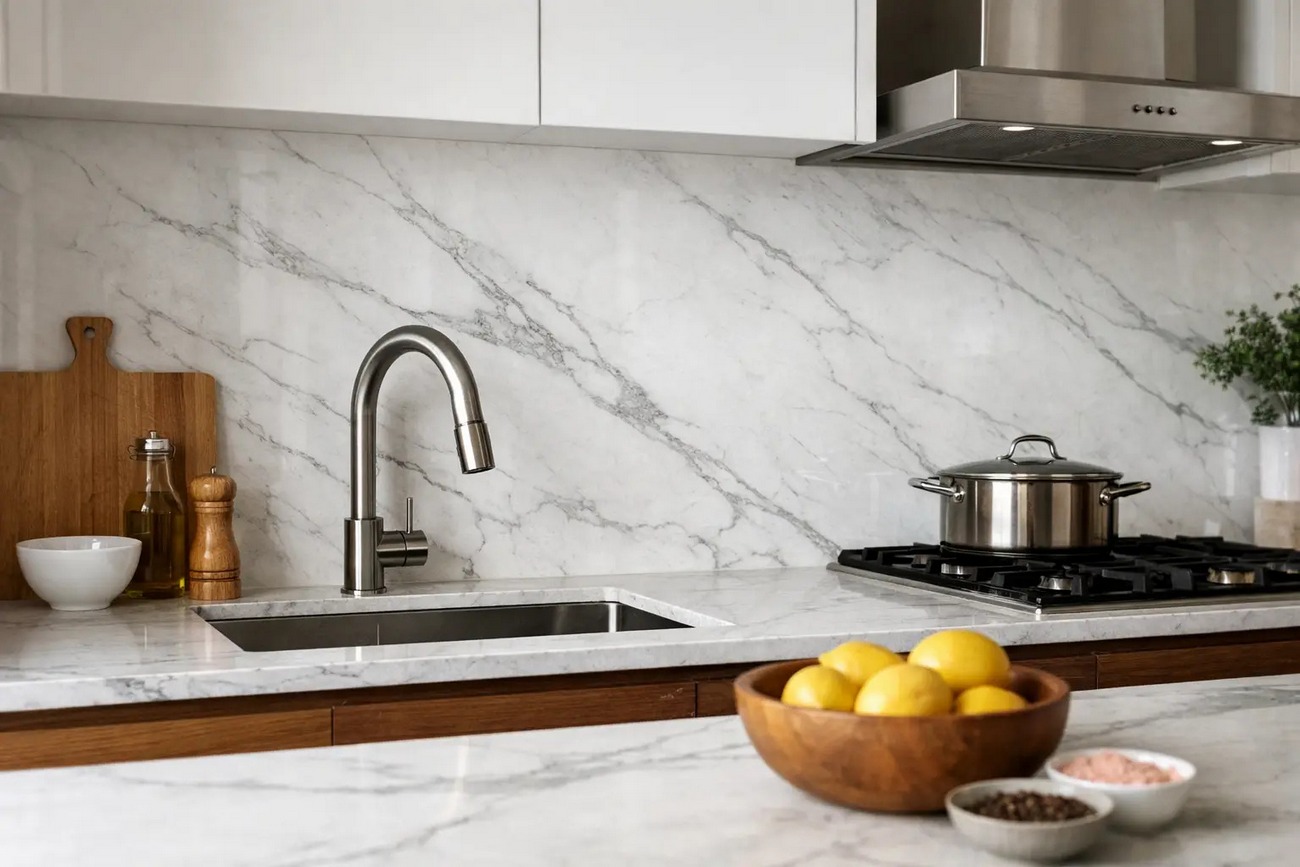
Large stone panels give kitchen walls an uninterrupted pattern with fewer joints to clean. Your choice depends on cooking habits, material care, wall coverage, and installation costs.
A solid slab backsplash can match your countertops or introduce a contrasting color behind the range. Plan the material and layout together so seams, outlets, and exposed edges work with the design.
Review actual samples under your kitchen lighting before committing. A finish that looks subtle in a showroom may appear more reflective beneath cabinet lights.
What is a slab backsplash?
Instead of covering the wall with individual tiles, fabricators cut large panels to fit the space. These panels can extend a short distance above the counter or continue toward cabinets and ceilings.
Large panels protect the wall while displaying a broad section of the material’s pattern. It usually has fewer joints than tile, although corners, long runs, and installation access can require separate pieces.
The surface still needs carefully finished connections at the countertop, adjoining walls, and fixtures. These details affect appearance and help keep splashes from reaching vulnerable areas.
Coverage and visual continuity
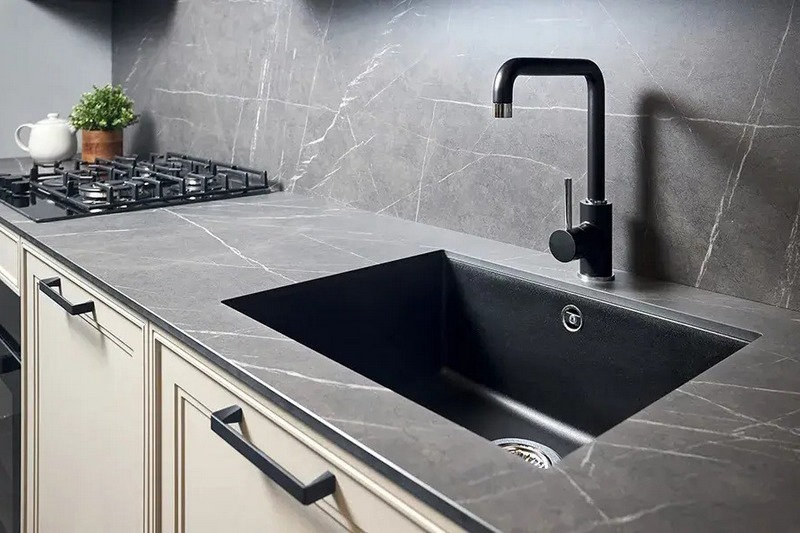
A solid backsplash describes a continuous panel treatment, not necessarily a plain color. Veining, mineral flecks, and contrasting bands can become prominent features across a large wall.
Choose the focal point before approving the cutting layout. A striking vein might sit behind the range, while quieter sections work beneath cabinets.
Matching the countertop material creates visual continuity, but patterns do not automatically align where horizontal and vertical surfaces meet. Ask to see the proposed arrangement before fabrication begins.
Best materials for a stone slab backsplash
Quartzite, granite, and engineered quartz offer different appearances and care requirements. Compare specific products and actual slabs because broad material labels cannot describe every variation.
Choosing a wall surface starts with deciding how much natural variation you want. Then confirm that the selected material suits the intended wall location and cooking setup.
Natural stone varies between slabs, even under the same commercial name. Engineered products offer more controlled patterns, although samples may show only a small portion of the design.
Quartzite slab backsplash
Quartzite appeals to homeowners who want natural veining, often with a lighter background. Its mineral structure can produce soft bands, crystalline areas, or pronounced movement.
A quartzite slab backsplash makes those details visible across a broad surface. Review the complete slab rather than choosing solely from a small sample.
True quartzite generally resists common kitchen acids, but stone sold under that name may sometimes be marble or dolomitic material. Ask the supplier to verify the stone’s identity and expected performance.
Sealing needs depend on the stone’s absorption and any existing treatment. Request care instructions for the exact selection instead of assuming every variety follows the same schedule.
Granite backsplash
Granite offers natural patterns ranging from fine mineral flecks to sweeping bands. Dark, pale, warm, and cool options make it suitable for different cabinet finishes.
A granite backsplash can coordinate with an existing countertop when a compatible slab is available. An exact match may be difficult if the original material came from another batch.
Some varieties need more stain protection than others. Confirm whether sealing is appropriate and how to recognize when protection needs renewal.
Inspect the finish under angled light as well as straight on. Polished surfaces reflect more light, while textured finishes can change how grease and cleaning marks appear.
Full quartz backsplash
Engineered quartz combines mineral content with binders and pigments. It offers controlled colors and patterns, with many designs intended to resemble natural stone.
A full quartz backsplash can continue the countertop design up the wall without introducing tile joints. Quartz generally requires no sealing, making routine care straightforward.
Heat exposure needs particular attention near cooking appliances. Confirm the surface manufacturer’s approval and the appliance clearances before selecting quartz for the range wall.
Compare large samples or slab photographs when choosing veined designs. Pattern scale and repetition can look different across a tall panel than across a small showroom sample.
Quick material comparison
Use this table to narrow your choices before reviewing individual slabs. Installation requirements and care instructions should still be confirmed for the selected product.
| Material | Appearance | Sealing | Main consideration |
| Quartzite | Natural veining and crystalline variation | Depends on absorption and treatment | Verify material identity and fabrication requirements |
| Granite | Mineral flecks, bands, or flowing patterns | Depends on the specific stone | Review slab variation and finish |
| Engineered quartz | Controlled colors and manufactured patterns | Generally unnecessary | Confirm heat exposure limits and clearances |
Countertop 4 inch backsplash vs. full slab backsplash
A short upstand protects the wall immediately above the counter. Taller coverage reaches the cabinets, hood, or another planned stopping point.
The countertop 4 inch backsplash option uses less material and leaves room for paint or another wall finish above it. Its nominal height is about 10 cm, though dimensions can be customized.
This approach can suit a modest update or a kitchen with limited splash exposure. The remaining wall still needs an appropriate finish wherever cooking grease or water reaches it.
When taller coverage makes sense
A full kitchen backsplash protects more of the wall and creates a larger visual feature. It can be useful behind sinks and cooking areas where splashes extend above a short strip.
Decide whether coverage should stop beneath cabinets or continue around a hood. Draw the boundary on a wall elevation so the installer can price the intended scope.
Avoid choosing height from a photograph alone. Window trim, cabinet alignment, and ceiling changes may require different stopping points in your room.
Planning edges and transitions
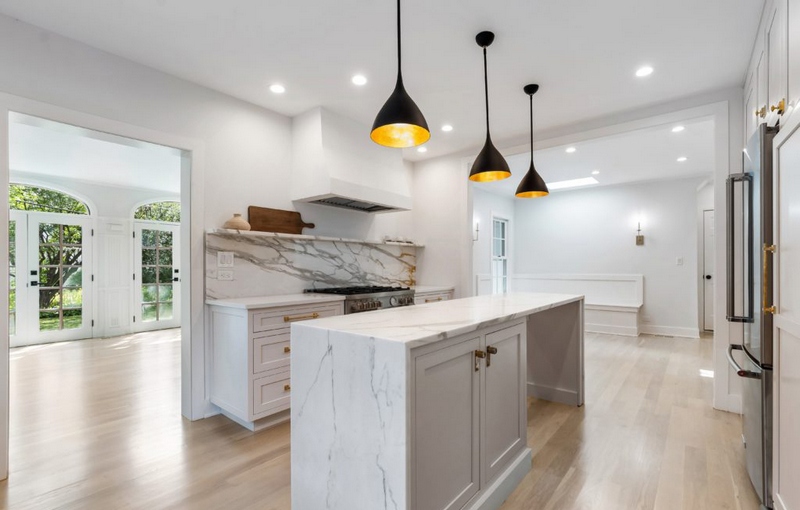
A full height kitchen backsplash needs clear decisions about side edges, window returns, and the area behind the hood. These details influence panel sizes and the amount of visible finishing.
Check how the surface meets adjacent painted walls. A thick exposed edge may need a different treatment from a panel enclosed between cabinets.
Allow access for appliance servicing and electrical work. Outlet positions and cover plates should be coordinated before cutting, because moving an opening afterward can be difficult.
Cost factors
The installed total includes more than the visible wall area. Material purchases, fabrication, wall preparation, transport, and installation all affect the quotation.
A small wall may still require purchasing a complete slab. Conversely, a suitable countertop offcut may reduce material costs if its dimensions and pattern work.
Material use and fabrication
Rare colors, dramatic veining, and complex matching can increase costs. Quartzite may also require more fabrication time because of its hardness.
Ask whether the quotation includes the following items:
- Material allowance: Slab quantity, usable dimensions, and any suitable remnants.
- Fabrication: Outlet openings, edge finishing, seams, and pattern alignment.
- Wall preparation: Removal of existing finishes and correction of uneven areas.
- Installation: Delivery, handling, setting materials, and required supports.
- Trade coordination: Electrical adjustments, appliance access, and final sealing where appropriate.
Compare quotations with the same coverage, material, and finish. A lower price may exclude work that another contractor has included.
Installation planning
A solid backsplash for kitchen renovations should be measured after the relevant cabinets and countertop positions are established. Accurate templates reduce the risk of poorly fitting panels and misplaced openings.
Agree on the installation sequence with the fabricator. Large panels need a clear route through doors, hallways, and stairs.
Follow this order when preparing the project:
- Define coverage: Mark the intended boundaries and identify exposed edges.
- Confirm compatibility: Review the selected surface and appliance installation requirements.
- Finalize positions: Establish counters, outlets, fixtures, and hood locations before templating.
- Approve the layout: Check panel divisions, vein direction, and visible seams.
- Inspect completion: Review joints, finished edges, and care instructions before signoff.
Ask who is responsible for each trade before work starts. Clear responsibilities help prevent delays between fabrication and installation.
Maintenance & durability
Daily care depends on the material and finish. Prompt cleaning usually requires less effort than removing dried grease or mineral deposits.
Use a soft cloth and a cleaner approved for the surface. Rinse away residue when instructed, then dry the area to reduce streaks.
Cleaning and stain prevention
Avoid choosing cleaners by scent or general household use alone. Abrasive powders, strong chemicals, and acidic products may damage certain finishes or treatments.
Follow the manufacturer’s directions for stubborn marks. Scraping with metal tools can leave damage that is more noticeable than the original spill.
Natural stone may benefit from an impregnating sealer when appropriate for its absorption. Sealing improves stain resistance but does not make the surface stainproof or eliminate cleaning.
Joints, heat, and repairs
Inspect the connection between the slab backsplash and countertop periodically. Cracked or separating sealant needs attention before repeated splashes reach the gap.
Keep heat exposure within the approved installation conditions. Material durability does not remove the need to follow appliance clearances.
Chips can sometimes be repaired, but the result depends on their location and the material’s pattern. A major crack may require replacing a large section, making careful handling and installation worthwhile.
Pros and cons of slab backsplashes
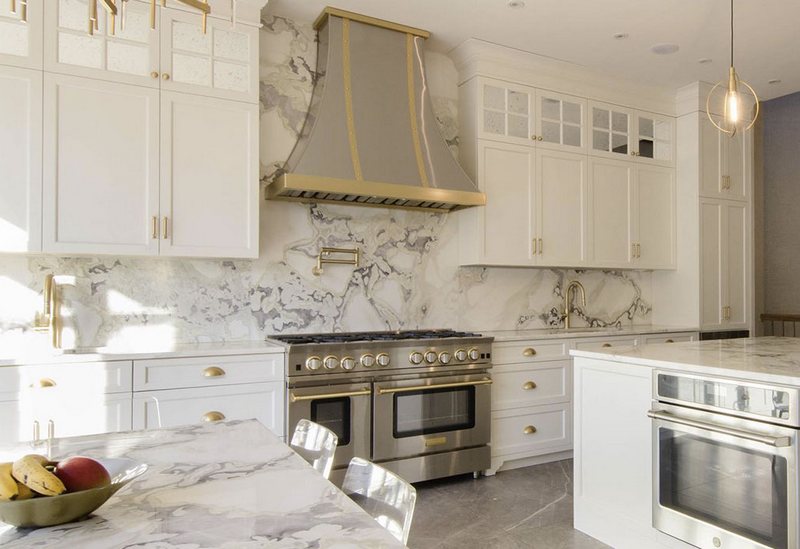
Large panels reduce the number of joints across the wall and keep patterns visible. Their value depends on whether those benefits justify the fabrication and installation costs for your kitchen.
Practical advantages
A broad surface can make routine wiping easier because there are fewer grout lines. It also gives you more control over where major veins or color changes appear.
- Cleaning access: Broad panels provide fewer joints where grease can collect.
- Pattern display: Large sections preserve more of the material’s natural or manufactured design.
- Coordination: Matching counter and wall surfaces can simplify material selection.
- Wall coverage: Custom dimensions let protection follow the planned kitchen layout.
These advantages depend on good detailing. Awkward seams or poorly positioned outlets can interrupt an otherwise cohesive design.
Limitations to consider
A stone slab backsplash is heavy and requires professional handling. Transport access, wall condition, and installation support should be assessed before ordering.
Changing the layout later can be expensive. Moving outlets, adding fixtures, or replacing cabinets may affect existing openings and panel edges.
Tile offers more opportunities to replace a small damaged area. Slabs can require a broader repair, particularly when matching material is unavailable.
Choosing a workable design
Bring cabinet samples, countertop details, and appliance specifications to the selection appointment. Include photographs and approximate wall dimensions so the discussion covers the actual room.
Luxiomer offers quartz, quartzite, and granite selections alongside fabrication and installation services. Request an itemized estimate for your preferred material and coverage.
Review the proposed layout before approving fabrication. This gives you a chance to resolve visible seams, edge treatments, and pattern placement while changes are still practical.