
Kitchen prep involves intense thermal changes. Hot cast-iron skillets, boiling pasta water, and baking sheets fresh from a 450 °F oven all need a place to land. Setting a scorching pan on the wrong material causes cracked slabs, discolored resin rings, and permanent surface blisters.
Selecting the right slab saves thousands of dollars in repairs. This guide covers how raw materials respond to high temperatures, compares laboratory ratings against real cooking conditions, and details which surfaces deliver reliable performance in active kitchens.
What makes a countertop heat resistant?
Thermal performance depends on atomic structure, chemical composition, and the presence of synthetic additives. Homeowners frequently ask what countertops are heat resistant and why stone slabs react differently to identical temperatures. The answer comes down to 4 physical properties:
- Binder Chemistry
Natural stone and kiln-fired ceramics consist entirely of compressed minerals. They contain 0% organic resin. Engineered quartz, solid surface, and laminate rely on polyester or acrylic resins to bind crushed particles. Mineral components withstand temperatures above 1000 °F, but polymer resins melt, scorch, or discolor between 150 °F and 300 °F. - Thermal Shock Tolerance
Thermal shock occurs when rapid temperature shifts cause one section of a slab to expand while the surrounding area remains cold. The boundary between hot and cold zones develops tensile stress. Dense, brittle materials with high thermal expansion rates crack under sudden swings. Slabs with low thermal expansion handle sudden localized temperature drops or spikes without fracture. - Thermal Conductivity
Materials with high thermal conductivity pull heat away from the contact point and distribute it across the slab. This rapid heat dissipation prevents intense local hotspots. Dense natural stones like soapstone spread thermal energy quickly. Low-conductivity materials retain concentrated heat in one spot, which elevates thermal stress at the perimeter of the hot cookware. - Porosity and Internal Moisture
Moisture trapped in microscopic stone pores vaporizes when exposed to intense heat. If steam cannot escape through open pores, internal pressure builds within the crystalline grid. This pressure leads to micro-fissures or surface spalling in unsealed, moisture-saturated stones.
Heat resistance of common countertop materials
Evaluating heat resistant countertop materials requires distinguishing between ambient temperature limits and direct contact thresholds. Ambient heat refers to radiant warmth from nearby cooktops. Direct contact heat involves setting cookware heated to 300 °F or higher directly on the slab.
The table below breaks down the technical thermal thresholds, thermal shock vulnerability, and direct pan tolerances across common kitchen surfaces.
| Countertop Material | Composition Type | Safe Contact Limit (°F / °C) | Max Tolerance Limit (°F / °C) | Thermal Shock Vulnerability | Safe for Direct Hot Pans? |
| Porcelain / Sintered Stone | 100% Sintered Minerals | 1000 °F / 538 °C | 2000 °F / 1093 °C | Extremely Low | Yes |
| Soapstone | Natural Metamorphic Talc | 1000 °F / 538°C | 1800 °F / 982 °C | Extremely Low | Yes |
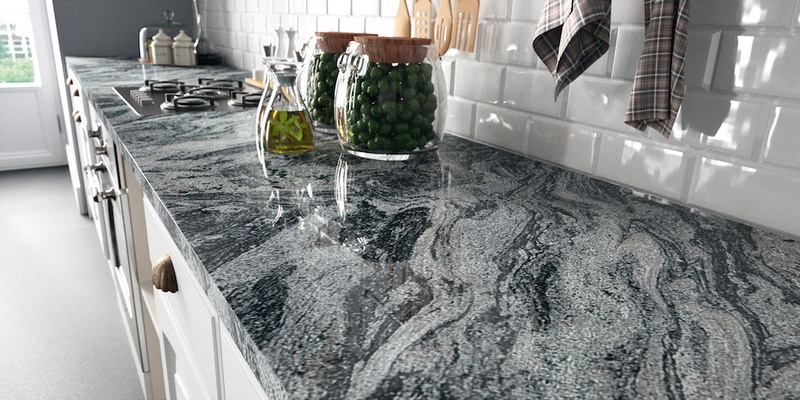
| Granite | Natural Igneous Plutonic | 400 °F / 204°C | 1200 °F / 649 °C | Moderate | Conditional (Sealer Dependent) |
| Quartzite | Natural Metamorphic Sandstone | 450 °F / 232 °C | 1000 °F / 538 °C | Moderate | Conditional (Sealer Dependent) |
| Stainless Steel | 16-Gauge 304 Alloy Steel | 500 °F / 260 °C | 1400 °F / 760 °C | Low | Yes (May Discolor Temporarily) |
| Concrete | Cast Cement and Aggregates | 300 °F / 149 °C | 800 °F / 427 °C | Moderate to High | No (Topcoat Sealers Degrade) |
| Engineered Quartz | 90% Ground Quartz, 10% Resin | 150 °F / 66 °C | 300 °F / 149 °C | High | No |
| Solid Surface | 100% Acrylic / Polyester Polymer | 140 °F / 60 °C | 250 °F / 121 °C | High | No |
| Laminate | Kraft Paper and Phenolic Resin | 140 °F / 60 °C | 275 °F / 135 °C | High | No |
| Wood / Butcher Block | Organic Hardwood Fibers | 200 °F / 93 °C | 350 °F / 177 °C | Moderate (Scorch Risk) | No |
| Marble | Natural Metamorphic Carbonate | 350 °F / 177 °C | 900 °F / 482 °C | Moderate to High | No (Vulnerable to Heat and Acids) |
Best heat-resistant countertops
Choosing among the best heat resistant countertops means balancing direct pan endurance with daily maintenance, edge strength, and aesthetics. While marketers occasionally advertise completely heatproof options, laboratory physics confirms that no kitchen slab is 100% immune to extreme thermal shock. Some options, however, handle thermal stress far better than others.
Here is an in-depth breakdown of top performers.
Porcelain and Sintered Stone
Porcelain slabs and sintered stones offer near-total heat resistance for residential kitchens. Made from clay, feldspar, and silica pressed at over 5,000 psi and kiln-fired past 2,200 °F, finished porcelain will not scorch, smoke, or burn. You can place a 500 °F pan directly on an untreated slab. However, thin profiles (6–12 mm) can chip at the edges if struck. When supported by a solid substrate and mitered edges, porcelain forms a durable, non-porous heat resistant surface.
Soapstone
Long used in laboratories and wood stoves, soapstone consists of talc, chlorite, and magnesite. It withstands up to 1,800 °F without degradation, meaning hot pans and boiling water will not crack or burn it. With an absorption rate near 0%, it requires no heat-sensitive sealers. Registering 2.5 to 3.5 on the Mohs scale, soapstone is softer than granite and can scratch from knives or heavy iron cookware; regular applications of mineral oil or wax obscure these surface marks.
Granite
Formed under volcanic heat and compression, raw granite endures up to 1,200 °F before mineral bonds weaken, easily handling brief contact with hot pots. Caution is still required for two reasons: factory epoxy resins used to fill micro-fissures can yellow under high heat, and penetrating liquid sealers can burn away, leaving pale rings and exposing the stone to stains. High-density granite remains a dependable kitchen surface when properly maintained.
Quartzite
Quartzite is 100% natural stone formed from fused quartz sandstone—unlike engineered quartz, it contains zero synthetic polymers. Tolerating direct heat over 1,000 °F, quartzite scores a 7 on the Mohs scale, resisting scratches better than granite. However, setting scalding cookware on cold slabs in winter can cause thermal-shock cracking along fissure lines. Like granite, its protective sealers can degrade under direct heat.
Stainless Steel
Fabricated from 14- or 16-gauge grade 304 alloy, stainless steel heat proof countertops handle cookware over 500 °F without cracking, shattering, or burning. It dissipates heat rapidly, preventing thermal shock. Prolonged heat contact may create temporary blue or golden oxidation tints, which polish out with acidic metal cleaners. While virtually indestructible thermally, stainless steel exhibits an industrial look and shows light scratches and water spots over time.
Concrete
Cast concrete core matrices tolerate heat up to 800 °F without melting or burning. However, its chemical sealing coats (polyurethane, epoxy, or wax) degrade and bubble at roughly 300 °F. Placing a hot skillet on sealed concrete scorches the topcoat, requiring sanding and re-sealing.
Heat resistant kitchen countertops: what to consider
Selecting heat resistant kitchen countertops requires reviewing structural and lifestyle factors beyond laboratory heat ratings:
- Slab Thickness and Underlayment Support: Thicker slabs (3 cm / 1.25 in) handle thermal stresses better than thinner (2 cm / 0.75 in) cuts. Thinner stone requires plywood sub-tops that expand at different rates than the stone above them, which increases stress during sudden temperature swings.
- Sealer Chemistry and Frequency: Natural stones need penetrating impregnators. If your cooking style involves pulling searing iron skillets off high-output burners, ask your stone fabricator for fluoropolymer-based impregnators rather than standard silicone-based sealers. Fluoropolymer seals endure higher heat spikes before breaking down.
- Presence of Natural Fissures and Veining: Heavy veining in marble, quartzite, and exotic granite indicates structural transitions between different mineral zones. These transition boundaries expand at unequal rates when heated. Slabs with dense, uniform grain structures resist thermal shock far better than slabs crossed by large open veins.
- Cooktop Cutouts and Structural Overhangs: Thermal cracks regularly originate around internal corner cutouts for cooktops and sinks. Fabricators must cut smooth, rounded radii on all inside corners rather than sharp 90-degree square notches. Square inside corners concentrate mechanical and thermal stress, leading to hairline fractures when hot pans rest nearby.
- Daily Maintenance Protocols: A countertop that survives high heat must also withstand everyday kitchen spills. Soapstone handles heat flawlessly but requires waxing to mask oil marks. Porcelain resists heat and stains completely but requires skilled fabrication to prevent edge chipping along perimeter profiles.
How to protect countertops from heat
Even on highly durable surfaces, deliberate habits protect your investment and maintain factory warranties. Stone fabricators recommend consistent surface protection across all installations.
- Use metal trivets with raised silicone feet beneath cast-iron pans, Dutch ovens, and air fryers to keep heat from soaking directly into the slab.
- Place protective insulating mats beneath continuous heating appliances like slow cookers, countertop roaster ovens, and electric griddles that radiate heat for 4 to 8 hr straight.
- Avoid resting boiling cookware near sink cutouts or unsupported cantilever overhangs where stone density is thinnest.
- Clean cooking spills immediately with pH-neutral stone soap so hot grease does not bake into stone micro-pores.
- Re-apply professional penetrating stone sealers every 12 to 24 months on granite and quartzite to prevent hot liquid absorption.
Frequently Asked Questions
What are the most heat resistant countertops?
▼
Can hot pans crack quartz countertops?
▼
Are laminate countertops heat resistant?
▼
Does heat damage granite sealant?
▼
What countertops can you put hot pots on?
▼